


Welcome to neuewave!
It’s been a month of non-stop celebration at neuemotion. From turning our agency’s second birthday party into a science-backed, case study (“Building a 2nd Birthday: A B2B Case Study”), and Toast’s “It’s The Little Things” Campaign being selected as a finalist for the Shorty Impact Awards in not just one, but two categories, we’re coming into the end of the year on a high note.
But among the celebrations, we have still been tapped into internet culture and the many trends that have arisen with it. As we look across the internet landscape as it responds to chaos of the world, the trends we have seen have outlined an even bigger story around context. Not just how important it is to understanding the world, but how it’s become a cultural currency in it’s own right in building connections and trust that feel human. This month, we explore four cultural shifts and how they are reasserting the value of the genuine human experience through shared context.
Let’s dive in.
🔢 Numerical Memes…
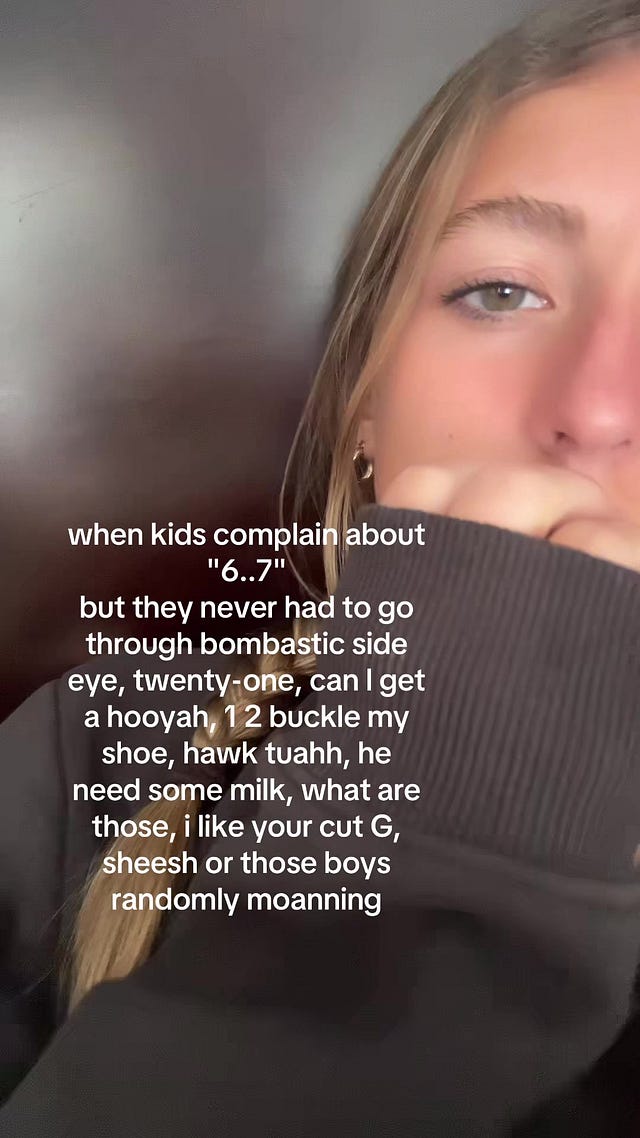
Every digital generation has a collection of memes and online jokes that define them. From “damn daniel” to “I just lost the game”, these connective, comedic tissues have become a way for generations to find identity and community among those who uniquely “get it”, accompanied by a sense of pride when outsiders don’t “get” it. However, as Gen Z and Gen Alpha become a digital generation, the next generation’s inside jokes are a variety of numerical memes and jokes that have left older generations both annoyed and confused– as nature intended.
The slang that has found its way into nearly every conversation, every exchange of words, every response to a question in which children as young as elementary age are involved, is the prime example of how these numerical memes are beginning to take hold. While the adults catching on to the 6-7 meme might inevitably kill it altogether, Millennials and Gen X are feeling left out enough of the new lingo to seek out explainer videos, yet still reject the phrase for its pointlessness. But regardless of its point—or lack thereof, it still serves as a cultural force for youth to form community and connection, just as “what are thoooose” did for generations past.
 Tiktok failed to load.
Enable 3rd party cookies or use another browser
Even if it’s a nonsense term, if they seem to know what it means, then it’s function as a generational connector that allows the younger generation to distinguish themselves among the broader culture has served an important purpose. And its importance can’t be ignored, Dictionary.com just named “6-7” as “word” of the year for 2025, citing both its widespread usage and how it has influenced culture over the last year. And no, a number being named word of the year is something we’re not ready to discuss yet…
How this shows up on social:
While 6-7 has undoubtedly taken over social, another recent numerical meme—being in “Group 7”—originated overnight after rising Gen Z musician, Sophie James organized her content into groups to easily identify who was seeing her content While all of her “groups” have now surpassed a million views, Group 7’s video garnered the most views, creating a ripple effect through Instagram and TikTok, people bonding over their Group 7 superiority and camaraderie. Brands, users, and celebrities alike jumped into the phenomenon, including DWTS pros and contestants—who we know are driving a cultural renaissance among Gen Z on their own.
Brands should prepare: as slang continues to evolve with new generations, there will always be pressure to adapt and show that they speak their language. At a minimum, brands should ensure they understand the origins/what the meme means before jumping into the conversation, as understanding the context is crucial to ensuring it hits with the younger generation.
🎨 Creativity Demands Context
The public reaction to AI and its increasing use in creative industries is inspiring a new behavior: audiences are championing behind-the-scenes content that adds context to how viral creative is made. This has been a growing trend in consumer goods for many months now, as the rise of fast fashion and mass-production has inspired consumers to celebrate human craftsmanship more than ever. Fashion house Loewe has responded to this not just by showcasing their products, but showing real people making their products, centering craftsmanship, human connection, and slow production as the star of their content.
With the rise of generative AI and creativity being offloaded to online tools, the value of creative, handmade work is more important than ever before, and consumers continue to be interested not in just the output, but the context of the creative process. How was this made? Who worked on it? What methods were used to create these visuals or effects? As AI becomes increasingly difficult for consumers to identify, leading with the context and effort behind the creativity sets brands apart, emphasizing transparency and trust for their users.
How this shows up on social:
AppleTV has been celebrated for their new “animated” title card after they revealed it was created with practical effects and cameras – no AI to be found. In a 30 second video documenting the process, props, and people behind the camera, it was clear that the provided context of how the visual was created feda broader public desire for human craftsmanship. One comment read, “In an era of heavy CGI and AI holiday ads, choosing a practical, in-camera approach is a statement. It’s creativity grounded in craftsmanship.”
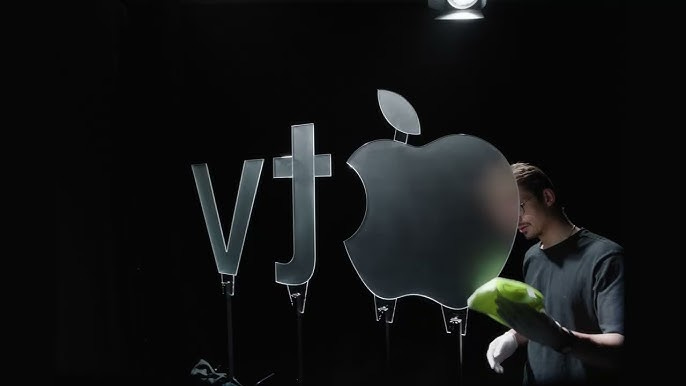
This reaction is similar to the breath of fresh air consumers felt for 2024 films Heretic, which slammed generative AI use in the closing credits, and Wicked, who prioritized practical effects to create the onscreen magic; all telling of the continued desire for the context surrounding creative work in the AI-era.
♟️Community Celebrity Hobby Groups
From book clubs, to knitting, to board games, to run clubs, there has been a well-documented boom in hobby adoption and communities as a way for people to connect with others and unplug.
In a post-pandemic world where we all learned the vital importance of human connection, coupled with increasing socioeconomic stressors, the desire to put phones down and pick up a hobby that feels purposeful and connective has led to users having more fulfilling offline lives and communities.
However, for a generation that remains thoroughly online, the very real presence of parasocial relationships with celebrities and creators they love remains paramount, with social media constantly serving as a platform for intimate access.
There is now a growing shift in bridging this gap, where fans are looping their authentic, purposeful offline interests into their public digital identities, creating a critical intersection where celebrities are now beginning to use shared hobbies as a new mode of connection. We have seen this play out for a long time through celebrity book clubs, with Dua Lipa, Reese Witherspoon, Kaia Gerber, Noname, and many more having long-standing book clubs that they use to connect with fans through a shared hobby. Similarly, we have seen fans turn to people like Ella Emhoff and Tom Daley, not for their skills that made them famous, but for their love of crafting.
But now we are seeing a profound shift in what it means to be a “fan,” by shifting the relationship beyond simple admiration of a star’s creative work and toward a sense of genuine connection through a shared affinity.
How this shows up on social:
Today’s fan culture is evolving from “I like this celebrity” to “we share the same passions”, and this month there has been clear examples of how beloved icons are actively involving their fans in hobby-centric moments to create connection.
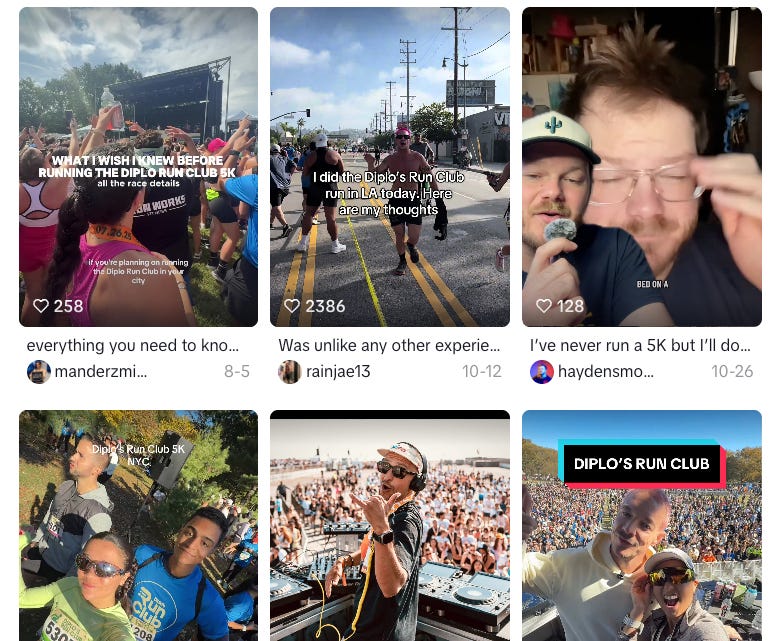
This month, Diplo turned his fitness routine and love for running into a communal experience with his run clubs, inviting physical participation and decentralized community building among his global following, with his most recent running event attracting 13,000 runners to sweat with him.
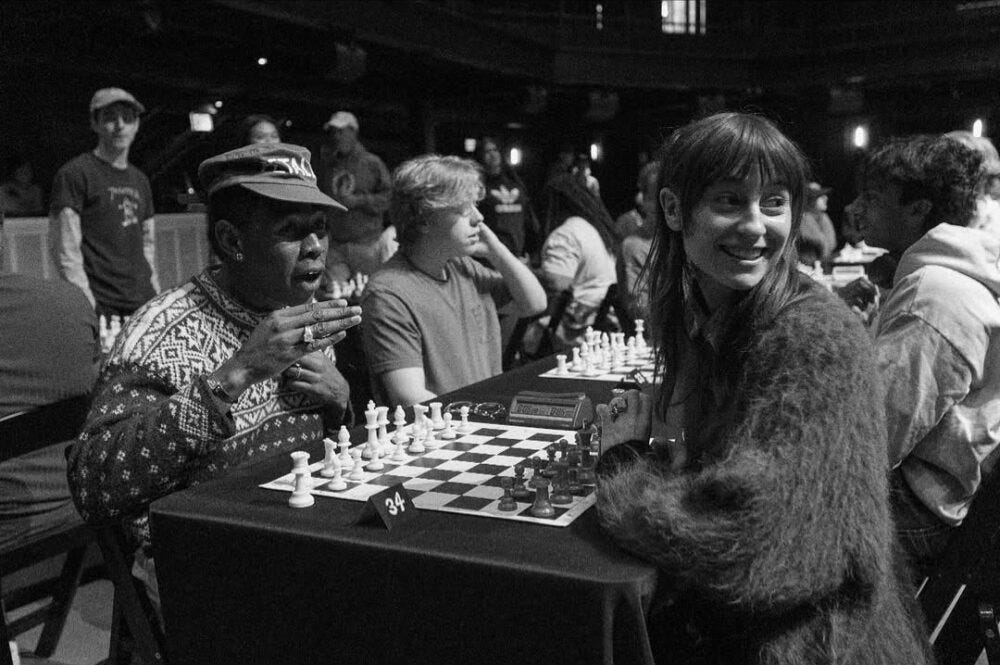
And, perhaps the most telling example of how hobby culture has been used as a mode of conenction with fans is Faye Webster’s annual Invitational that was held in Atlanta this October. The Invitational was multi-event gathering centered around her niche passions, which includes a competitive yo-yo showcase, liveball tennis tournament, and a chess tournament. Oh, and not only did Faye Webster herself compete in the games, Tyler the Creator, among other celebrities, attended to play in the chess tournament amongst fans, blurring the lines between celebrity and community building through shared hobbies.
🤷♀️ Public Apathy
There is a freedom in not caring. In our world, where there is so much to care and worry about, the desire to be carefree and unbothered is now replacing the previously romanticized narratives we have seen on social media through trend formats like the “almost forgot this was the whole point” or “this and…” that typically showcase the beautiful or magical moments that make life better.
However, showcasing everything to be positive or whimsical has seemed to hit it’s breaking point on social media. The resulting apathy isn’t true nihilism; it is self-preservation. When every scroll delivers a fresh disaster—be it social, political, environmental, or economic—the human psyche reaches a saturation point where “toxic positivity” becomes unhelpful and unrelatable for many. So, instead of saying “life is beautiful and everything is happy,” users are opting for trends that say “life is chaotic, and scary, so stop overthinking and enjoy what you can.” A more relatable and realistic response that meets users where they are at.
How this shows up on social:
Recent trends have been pointing to a narrative that the real beauty is choosing not caring so much about things that aren’t worth it. Similar to the “almost forgot this was the whole point”, it’s newer, more apathetic counterpart, “girl whatever” has become the new copy over the top of serene, simple moments, a more nuanced call to action from users to just say whatever to stressors and focus on the simple joys of life.
A different but similar trend that has this energy has been the “sometimes you just have to read the text and move on”, where users reveal surprising, upsetting, or darkly humorous texts they have received, but taking back their own power by letting it roll off their back so they can move forward. While both trends mimic a recognizable content format, the shifting tone we are seeing across every iteration is telling of a wider public attitude toward finding peace in the chaos.
 Tiktok failed to load.
Enable 3rd party cookies or use another browser
In an era defined by AI-generated visuals, endless information, and global chaos, context has become the new king. It is what allows users to forge communities through new language, provides audiences with the proof of humanity they crave, and lets consumers build deeper connections through shared, tangible passions.
Users are hunting for deeper meaning and understanding, and it is a call for brands to embrace the human touch, celebrate shared experiences, and seek out the context of what connects with audience today. Those who provide depth—who show how they’re made, why they matter, and who is behind the work—will be the ones who successfully convert cultural currency into genuine human connection that leads to lasting trust.