


Welcome to neuewave!
Happy New Year! 2026 is in full swing, and we are excited to get into our first trend deep dive of the year. While the New Year always brings fresh energy, with everyone attempting to “lock in” to their goals, ambitions, and aspirations, social media is awash with content reflecting what people hope for in the upcoming year. In our analysis, it is clear that the future is about reclaiming the present and reliving the simpler days of the past.
Before we dive into the trends this month, we wanted to give a few shoutouts:
Congratulations to our very own Gabby Aidam for being selected as an honoree for the Campaign US Spark Awards Class of 2026! We are so lucky to have such a talented and thoughtful creative producer on the neuemotion team, and who makes beautiful graphics for this newsletter!
Last month, Assoc. Creative Strategist Hailey Allen went on the Meme Team Podcast to talk about all things trends, pop culture, and 2026 predictions. Check it out here!
Let’s dive in to what socials are looking like at the top of the year.
🕰️ Reclaiming our Time
2025 was the year we saw digital detoxes come to fruition– a real, necessary shift in culture to be on their screens less and in the world more. For 2026, where reducing screen time and pursuing more analog tools/hobbies is a common New Year’s goal, we will see a mass interest in moving away from screens to reclaim our personal time, and experience it as slowly and personally as we can.
This has never been clearer than in recent weeks, where it feels like everyone in our feeds got a Brick for Christmas– a physical device that allows users to lock themselves out of preset apps, and only “unbrick” it by physically tapping the phone to the device. The Brick has seen a serious increase in UGC content, with thousands of videos hitting social media feeds featuring people using their devices, or inquiring about if they should invest in one themselves. While it is not lost on us that you can lock apps in-device, there is something about having a physical device that keeps you grounded in tangible reality that makes this work.
How this shows up on social:
Reducing screen time is no longer just about “logging off”; it’s a radical reclamation of personal agency. We have seen a rise in “Brick my phone with me” content and an increased interest in offline documentation, with journal ecosystems and analog tour videos garnering thousands of views across social channels. There is an inherent irony in filming oneself ‘unplugging’ (and requiring a second device to capture the act of locking away the first), but the message clearly resonates regardless.
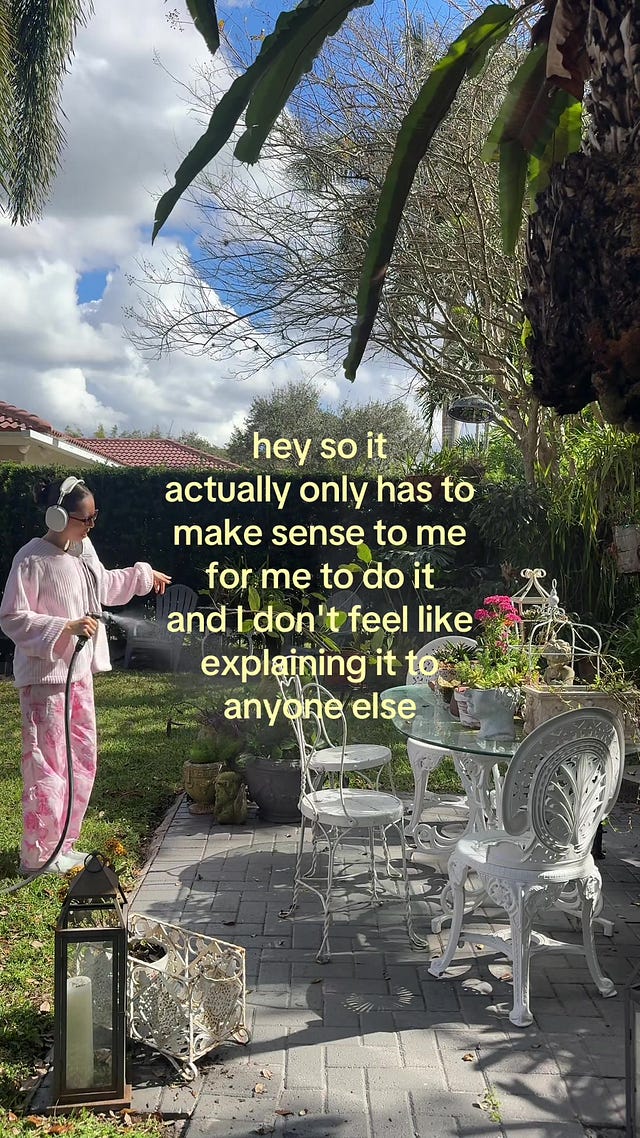
However, dare we say the first meme of 2026 had the intention of being more conscious of time and finding personal ways to reclaim it. Enter Tamara, a Tiktok user who has been reluctantly thrust into fame from her since deleted video where she says that she is going to get a jar of 365 buttons (yes, like shirt buttons), one for each day, and carry a new one in her pocket everyday to mark the passing of time, ending the day with transferring her button of the day to a new jar. This sparked an unexpected Tiktok movement (perhaps because it was perfectly random) as people flocked to her comments for clarification. Yet when the attention came, the creator fervently refrained from explaining herself further, responding back, “Hey, it only has to make sense to me for me to do it and I don’t feel like explaining it to anyone else.”
And thus, the motto of 2026 was born, with thousands of videos using the phrase, and people starting their own version of the button jar, including the St. Louis Cardinals and Girl Scouts, to collectively mark the passing of time and feel more connected to our everyday life.
 Tiktok failed to load.
Enable 3rd party cookies or use another browser
🌀 Tightening Nostalgia Loop
Where the internet moves at lightning speed and trends cycle faster than ever before, we have seen a shortening window in the “nostalgia cycles” as well. We used to have a 20-year nostalgia cycle; think of the 2000s kids loving the 80s or the 2010 borrowing from the 90s. However, social media has accelerated this cycle into a 10-year loop, with the 2010’s specifically coming to the forefront of people’s nostalgic hearts.
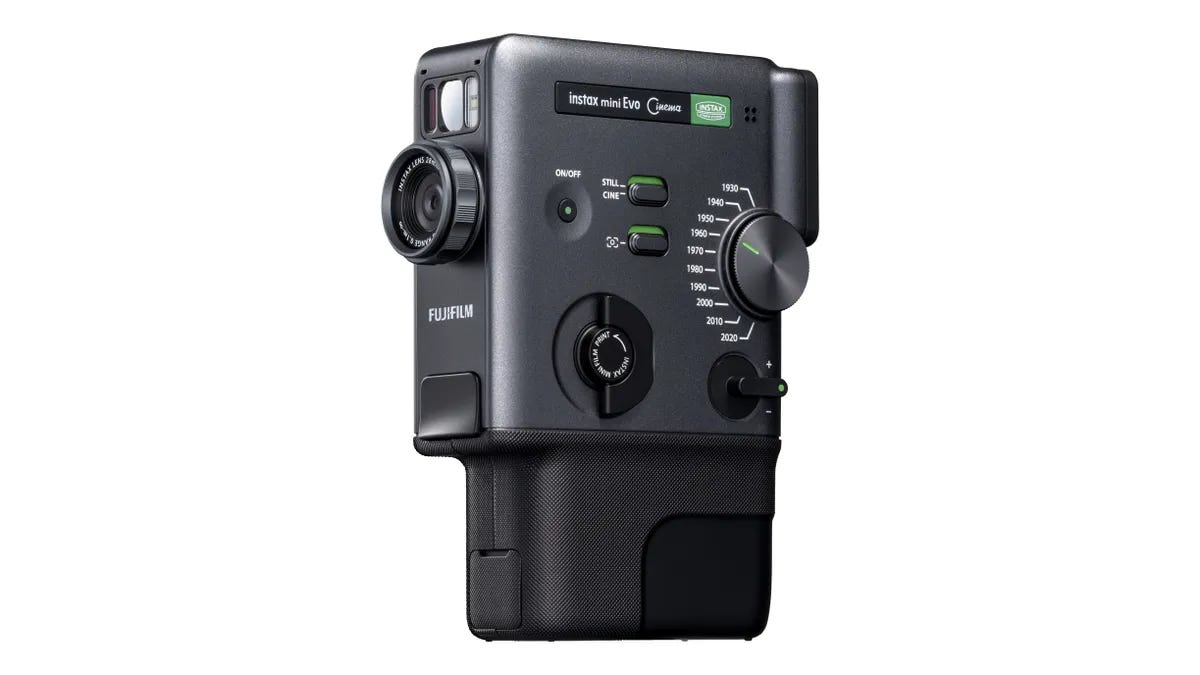
This is showing up in tech and pop culture: Fujifilm’s newest camera release includes a “Time-Travel” dial that allows you to make a photo look like it was taken in any specific year from 1950 to 2020, effectively turning the present into a curated collage of the past.
Meanwhile, the Kim Kardashian/Fortnite collaboration has fans obsessed with her “iconic moments” being rendered as skins and in-game opportunities— using short-term nostalgia to bring a new audience to the gaming space. We aren’t just looking back at decades anymore; we are looking to specific “internet moments” from just a few years ago and treating them like ancient history. The faster the internet gets, the more we crave the “old” versions of it, and the quicker we feel “nostalgic” for iconic eras and cultural moments.
How this shows up on social:
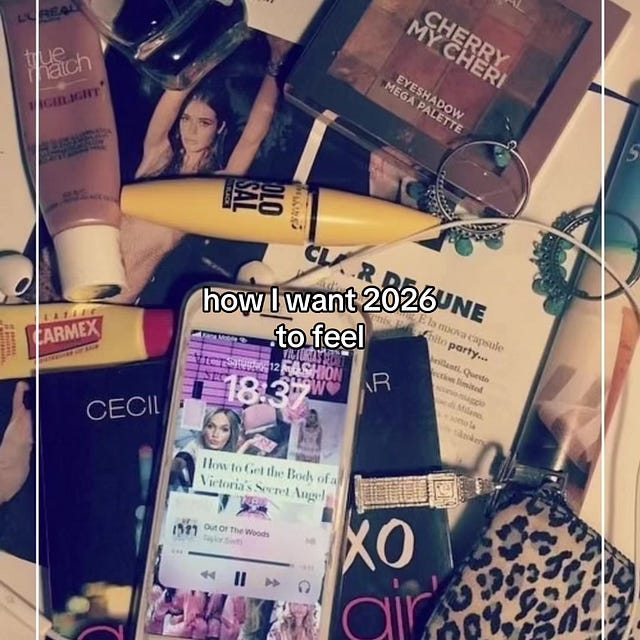
The consensus online is this: “2026 is the new 2016”. The romanticization of 2016 is not new– the summer, specifically. It has been chronicled throughout the years— a nostalgia for the soft grunge fashion, reddish photo filters, and pre-short form video explosion.
Now a full decade beyond 2016, we’ve turned a new leaf, one where people are declaring 2026 will be the new 2016– with the same energy that made 2016 so memorable in collective memory. There have been a series of parallels to 2016 that have led this movement, some more serious than others. Some have pointed to the new season of Stranger Things (which premiered in 2016), Kylie Jenner reviving her 2010’s King Kylie Era for Kylie Cosmetics, and even Ariana Grande going brunette again as a sign that 2016 is officially back.
 Tiktok failed to load.
Enable 3rd party cookies or use another browser
🎊 New Year, New Me
With a new year always comes the same content we can rely on: resolutions and manifestations for the New Year. Historically, New Year’s resolutions are usually centered around wellness goals– weight loss, healthier eating habits, etc. While we didn’t see a complete departure from the traditional goals, with the latest data from YouGov reporting the top priorities for 2026 are Exercising More (25%), Being Happy (23%), and Eating Healthier (22%), in our current world where we see growing concern over health and wellness messaging in pop culture and a desire to be more offline, it is no surprise that we are seeing more content surrounding non-traditional resolutions pick up steam as well.
How this shows up on social:
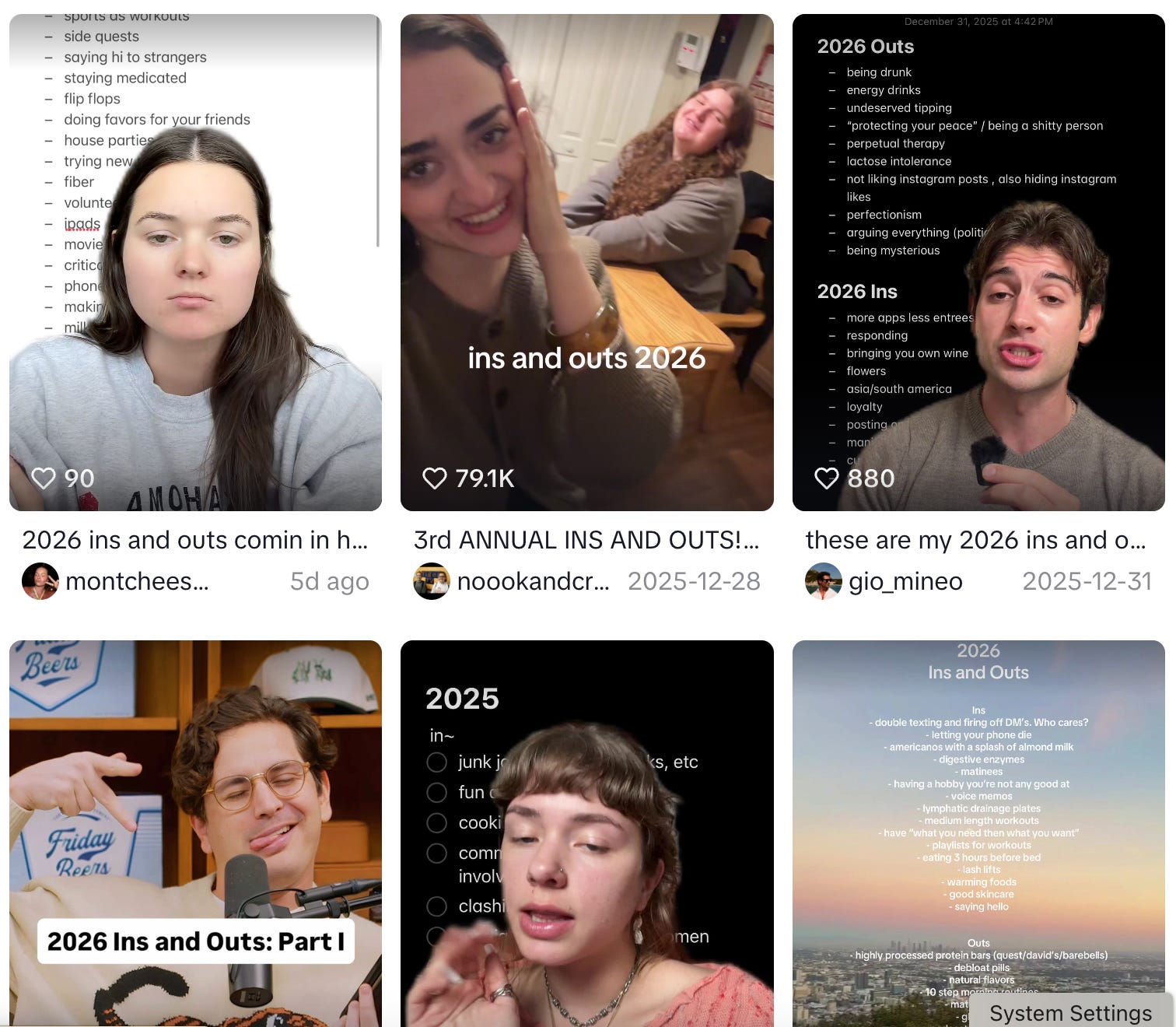
Feeds filled with New Year content is a social media tradition– from year before recaps, to in’s and out’s lists, to vision boards, to astrology predictions for the new year, users are excited to reflect and share what they hope for in a new year. The consensus is a lot of what we have been seeing throughout this year: more intentionality, self-care, and embracing individuality.
🧇 ConformityGate
When the Stranger Things finale dropped on New Year’s Day, it triggered a mass psychological event known as “Conformitygate.” Large swaths of the audience simply refused to believe the “conforming,” happy ending was real, theorizing instead that the characters were trapped in a mass illusion induced by the villain, and a secret 9th episode would drop on January 7th to reveal the “truth.”
Spoiler alert: there was no episode 9. However, that did not stop Stranger Things fans from crashing Netflix to hopefully be first to see the theory come to fruition.
Is it a harmless hopefulness for a better ending for something that is beloved, or a cultural inability to accept “The End” or a narrative as given? We have seen similar online behavior in the past, specifically with musicians like Taylor Swift or Harry Styles, where fandoms deep dive and pick apart the most minute details to find hidden meanings, easter eggs, or clues. However, this is the first we have seen of a TV show, especially one that ultimately never came to pass. And it wasn’t just a handful of superfans that bought into the conspiracy— with a Change.org petition reaching nearly 400,000 signatures in a matter of days demanding the full finale and deleted scenes be shared.
We wonder if this is simply another avenue for fans to craft deep analysis, a symptom of an increasingly hyper-personalized world, where people can use AI tools or tailor algorithms to experience a story or piece of media exactly the way they want to. If the ending doesn’t fit what they wish it was, then certainly it can’t be the “real” one… right? As we move further into this era of hyper-personalization, the real ‘mass illusion’ may not be the one on our screens, but the belief that we have the power to rewrite a story simply because we refuse to let it go.
How this shows up on social:
Regardless of why Conformitygate ran rampant online, it was unignorable. A myriad of deep dive videos, analysis, and theory swapping hit our feeds starting New Years Day.
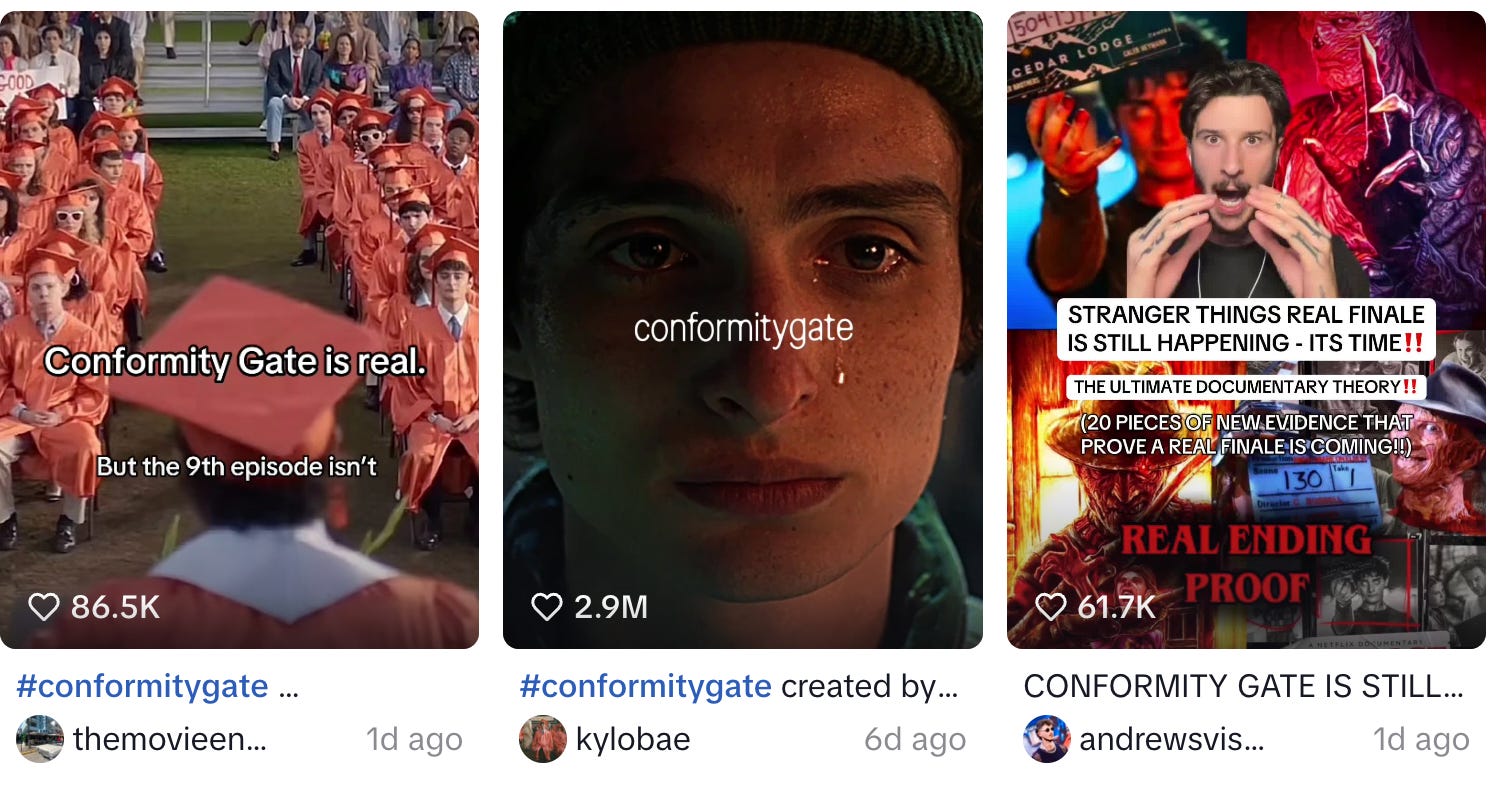
Netflix was in a precarious situation: do we let people keep having their delusional fun, or squash speculation to mitigate further disappointment? Netflix didn’t entertain the theories, but didn’t ultimately squash the rumor until it had already reached viral fame. And yet, fans were still convinced on January 7th that they were getting a secret episode.
The fallout has been a mixed bag. People that believed were disappointed, but most have seemed to move on to what was revealed in the post-finale documentary— much of which gave them answers as to why the finale was so bad in their eyes to begin with.
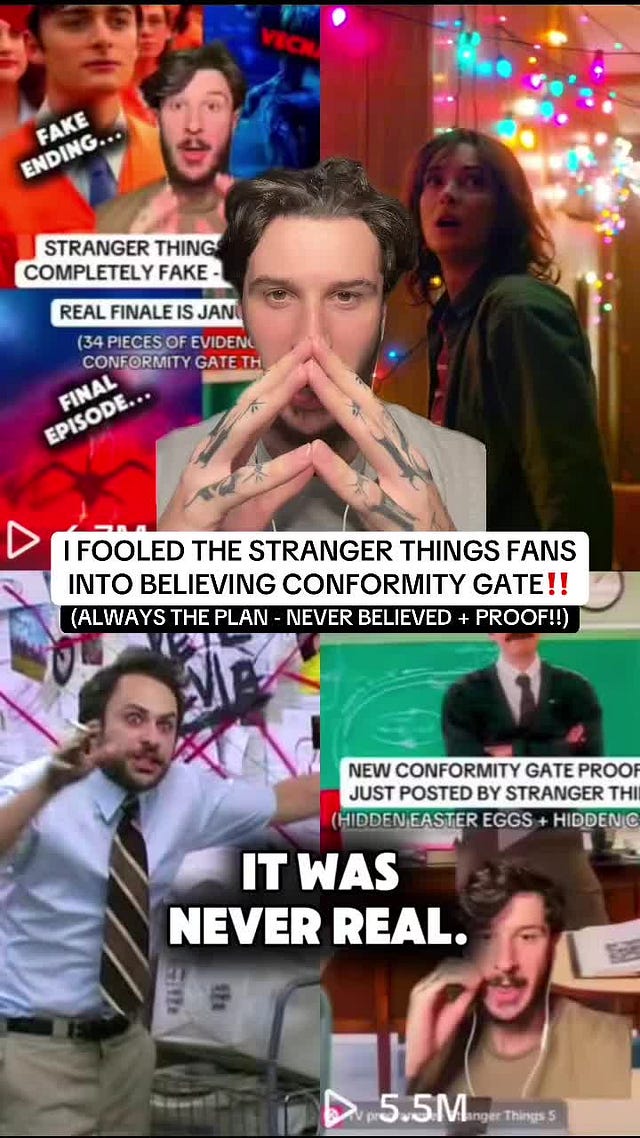
What has been most confusing about the fallout of this theory is the main perpetrator of the theory who posted over 25 videos explaining and furthering belief with viewers— some amassing millions of views, walking it back after words… posting a video titled “How I fooled the Stranger Things fans into believing conformitygate” on how he never believed from the start. A strange move when trust is more important to users than ever.
 Tiktok failed to load.
Enable 3rd party cookies or use another browser
Whether it’s locking our phones, or locking in to our New Year ambitions, the pulse of 2026 is defined by a deep desire for agency. We are no longer passive consumers of the digital age; we are actively negotiating our relationship with time, technology, and the narratives we consume to take back control and spend more time in the physical world. As we head further into the year, the goal isn’t just to be “online” or “offline,” but to be present in a way that, as our new motto suggests, only has to make sense to us.