


As the year comes to a close, we are reliably inundated with trend reports and outlooks for 2026. From Pinterest Predicts to Colors of the Year, these forecasts are often repackaged and delivered among agencies and marketers, everyone trying to put their own spin on the same handful of expected trends.
At neuemotion, we’re tired of simply predicting the future; we’re ready to propose a better one.
We asked our team of 20+ creatives from across the agency to offer their collective POV on the most anticipated—and most necessary—shifts in content, creator strategy, and platform trends fueled by our own strategic insights and cultural analysis. Inside, the team answers the question: “If you could control the trends, what would you want to see?”
Instead of telling you what’s coming (you’ll get that everywhere else), we’re sharing our internal perspective on what we wish 2026 will bring to social media.
Ready to see the social feeds of our dreams? Let’s dive in.
📡 Digital Comforts
We have seen a building affinity toward nostalgic hobbies and aesthetics in 2025. From the proliferation of VHSthetic, the comeback of 90’s-00’s technology, and the love for nostalgic franchises leading current marketing and online trends. The next frontier will be classic entertainment formats packaged as “new” offerings. This emerging trend capitalizes on the comfort and familiarity of past media, breathing fresh life into tried-and-true structures.
A prime example: the resurgence of long-form formats. Livestreams echo the live, immediate nature of classic television broadcasts, while long-form blogging and lengthy online videos serve as modern successors to deeply engaging magazine articles or thoughtfully televised documentaries.
We have also seen this resurface in the boom of chatroom-style mediums and app-integration like Discord, Instagram’s Channels and Close Friends stories, and Substack subscriber chat– mimicking the small chatrooms that those with AOL handles in the aughts remember fondly.
The audio world is perhaps where this trend will be most pronounced. Podcasts are increasingly mimicking the structure of traditional media, leading to a revival of familiar archetypes. Director of Strategy, Caitlin Kean, perfectly captures this sentiment, stating: “[I want to see] MORE OF podcasts disguised as talk shows. Every podcast has an interviewer/guest on camera in two chairs. Let’s just revive late night tv, y’all??” The doubling-down of audio and visual content is ever present in the seemingly random addition of the Golden Globe’s “Best Podcast” category. Nominated podcast, Call Her Daddy, featuring Alex Cooper’s high-profile interviews where she gets the dirt on pop culture scandals, is the perfect example of this late-night talk show packaged as a modern entertainment platform. Similarly, TikTok’s new live podcast “TikTok in the Mix”, a 4-episode series that leans into the rise of livestreams and late-night TV podcast formats to talk to major music artists, leveraging old and fresh formats to create a new offering by the platform.
We predict the next media structure to get a revival is the radio show, reimagined and infused with modern elements, especially on the heels of streaming juggernaut ‘Stranger Things’ featuring a radio show as a prominent plot point. We foresee the classic formats and styles of radio shows—snappy flow, sound effects, music, and live broadcasts—to make an impact on the audio space, signaling a wider appetite for the sounds and structures of the past. These familiar blueprints, re-skinned for a digital-first audience, will prove to be a familiar comfort in our nostalgic pursuit.
💫 Interesting Over Influential
People yearn for a time when the internet was a place of wild possibility, connectivity, and inspiration.
We’ve seen digital detoxes become more appealing, and users continue to call for technology and entertainment of the past. There is a clear cry for help coming from the online world: the internet feels draining, and we are craving for it to be inspiring again.
When we asked our team the kind of content they want to see in 2026, the answers told a story of authenticity, specificity, and discovery that inspires, uplifts, and educates.
I want to see…
“Real people doing real things, less influencers doing influencer-y things.”
“Genuine content that sparks positive and constructive conversation, hand-created, self-typed posts, things that show effort and process. ”
“Rewilding” the web. I just miss when websites felt like places. Or that you uncovered something.”
“I always want to see more art! And highlighting people with highly niche skills.”
“I’m loving the academic curation trend and want to see more of that in 2026.”
We see this sentiment across our team and in our audience research: people are less inspired by the lifestyle and experiences of the influencers made by the platforms, and more interested in seeing the kind of people online that we are inspired by when we meet them in real life. These people have niche hobbies, they’re educators who teach something new, and creatives who open us up to new communities or modes of self-expression. We crave online experiences that break the current mold and inspire us, rather than the same trends and creators day after day.
The time people spend online is a precious resource. Brands need to prioritize not just maintaining audience attention online, but leaving a meaningful impact on audiences when they go offline. The content that will resonate with audiences this year will feel singular to that person or platform—defined by the artist with a distinct perspective, the educator with deep knowledge, and real people who offer a genuine glimpse into a life unlike our own.
🧠 Consistency over Virality
As the social landscape becomes more chaotic and hyper-crowded, one thing is becoming clearer through our research: audiences are valuing consistency over one-off viral wins. For brands, maintaining a dependable cadence of content is no longer just a best practice, it’s a differentiator. People want to know what they can expect from the brand, and they want that expectation met repeatedly.
Director of Brand Strategy, Drew Nelson, noted, “Having one-off moments is cool, but if that’s not representative of what the rest of your content looks like, then it’s more of a flash than an archive of more content to discover.” In other words, virality without consistency does little to build long-term affinity or trust.
There’s also an important distinction emerging between consistency of volume and consistency of value. This shift isn’t about maintaining an aggressive posting cadence, but about being consistent in quality, usefulness, and clarity. That viewpoint is echoed internally as well, with Creative Director Michael Olson capturing it bluntly: “I want brands to post LESS.”
This shift also reflects a growing fatigue with trend-hopping for the sake of attention. Consumers are increasingly more discerning; they’re looking for clarity, depth, and actual value; whether that’s education, product knowledge, or storytelling that reveals something meaningful about a brand. Trend-bait feels increasingly hollow in comparison. For 2026, we want to see brands treat consistency like a strategy, not an afterthought.
🚨 Shock has no Value
If 2025 was the year of pushing the limits on shock, 2026 is the year we collectively hit the brakes. “Ragebait” - content engineered to provoke anger, confusion, or divisiveness - has become one of the most fatiguing trends on social and traditional media. There’s a reason it was Oxford’s word of the year.
Whether it’s alarmist email subject lines (think faux emergencies from retail brands, hi BÉIS), “urgent” SMS blasts, or click-bait thumbnails designed purely to spark outrage, these tactics were once effective because they helped brands stand out. Now, nearly everyone is doing it, and the result is a sea of sameness that feels manipulative rather than engaging.
Across the neuemotion team, the position is clear: people are exhausted by manufactured emotional spikes. Chief Customer Officer Christina Garnett noted, “Machiavellian marketing, provocation for the sake of performance, is going out. Coming in is a focus on the real. As AI is incorporated deeper into our lives and feeds, people will seek out what they can trust: in-person events, tools to determine if content is AI generated.”
This shift is accelerated by the rise of AI and the growing difficulty in deciphering what is real, edited, or engineered to provoke. In a climate of distrust, we believe consumers will gravitate more toward creators, brands, and formats that feel grounded, human, and emotionally safe. Shock tactics may generate short-term clicks, but in 2026, trust is the long-term metric that matters.
🖼️ Aesthetics
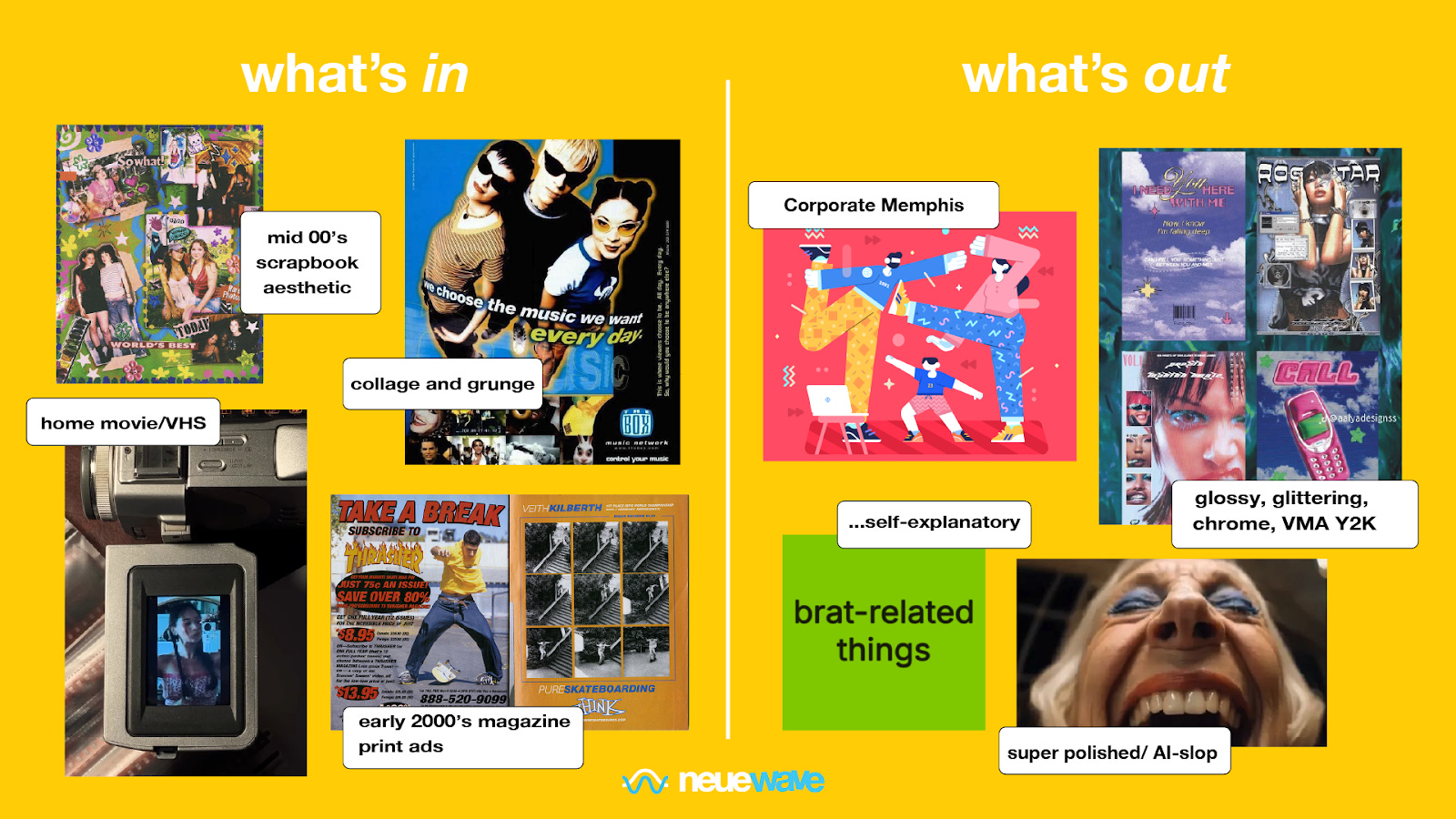
When asked, our team is continuing to heavily favor messy, real, and retro aesthetics for 2026, but is hoping to trade the Y2K aesthetic, glitter pen aesthetics, to embrace the mid-00s scrapbook, home movie, and vintage magazine styles that are hard to replicate by AI.
Conversely, the responses seek to eliminate highly curated and synthetic visuals and overly fake AI filters. The overall sentiment is a desire for human-made, unvarnished content that mimics artful aesthetics of the past.
☎️ Where Communities are Forming
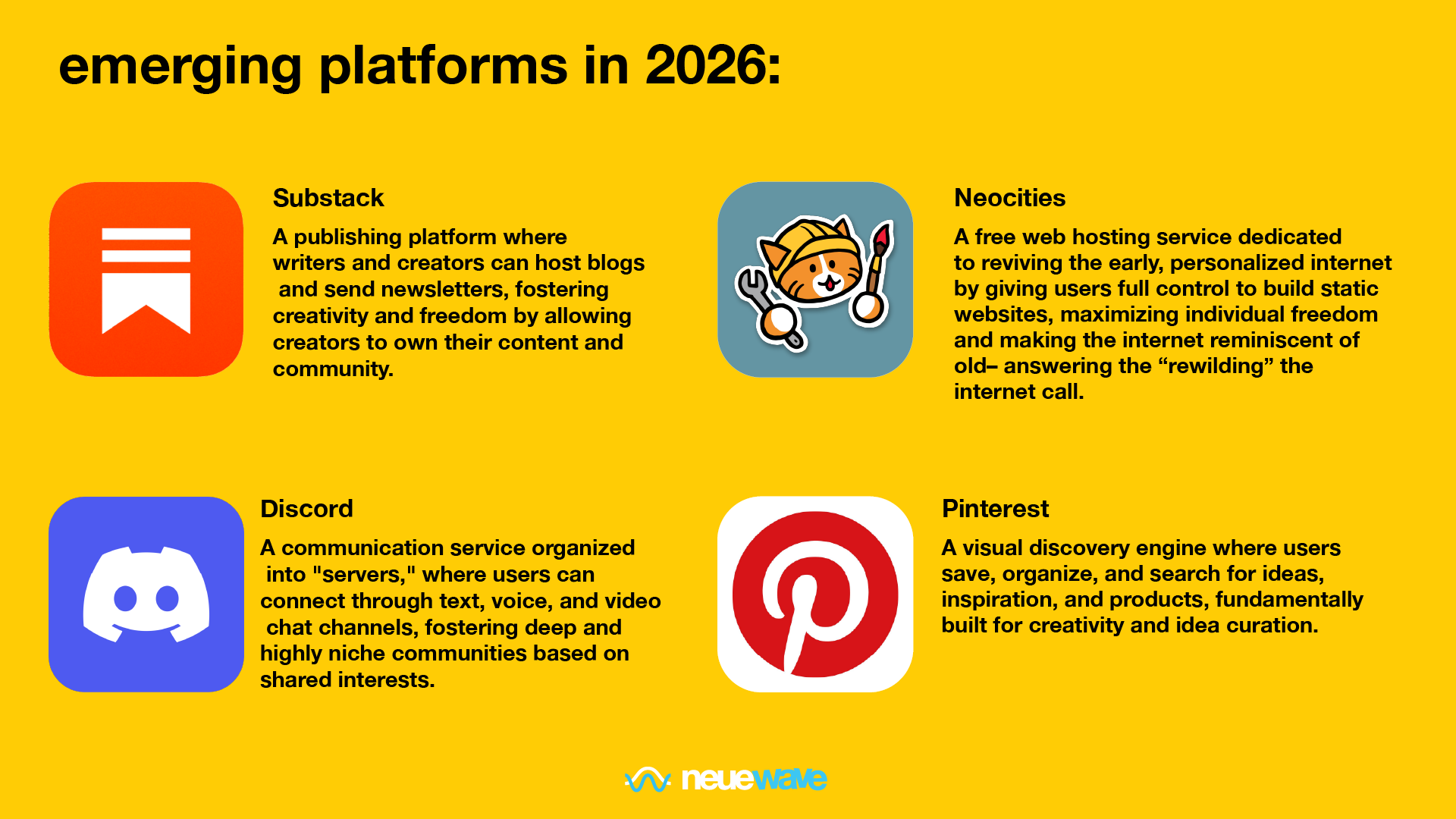
When it comes to platforms, we hope to see more prominent ones emerge for online connection and community building– defined by creativity, more freedom online, and smaller, more personable modes of communication.
Here are the top responses to the question of which platforms we expect to emerge in 2026.
✂️ Craft Over Clout
Influencers and creators continue to be some of the biggest needle-pushers for a brand’s success, or failure, but the criteria for who earns that influence is shifting quickly. Audiences are craving creators who feel real, trustworthy, and genuinely skilled at their craft. High-effort content stands out again, especially as the cost of living rises and folks relate to creators who are balancing a 9–5 while still producing thoughtful, quality work. As Director of Brand Strategy, Carlo Johnson noted, “Creators who are specialized in a unique trade or craft will be increasingly sought after and appreciated in a world where anyone can generate lazy AI content.” AI is a tool, not the star, and digital trust is becoming one of the most valuable currencies online.
We’re also seeing a growing opportunity for internal creators: founders, CEOs, and team members who become a brand’s most credible influencers. Halfdays is a standout example: co-founders Ariana Ferwerda and Kiley McKinnon’s personal content, from photoshoots and product testing to behind-the-scenes moments, has become a powerful top-of-funnel engine. This type of leadership-driven storytelling builds closeness, signals authenticity, and is often more cost-effective than traditional influencer partnerships. The comment sections reflect this clearly: audiences consistently ask for more, drawn to the feeling of being “involved” and getting a peek behind the curtain of products they genuinely use. That access creates a sense of intimacy and small-brand energy, even as the company scales. Expect more brands to lean into this model as trust, transparency, and craft continue to matter more than follower counts alone.
These shifts sit in sharp contrast to the fatigue around low-effort, profit-driven content: TikTok Shop hauls, endless affiliate links, and sponsored posts that feel disconnected from reality. The rise of de-influencing and “empties” culture is really a reaction to that fatigue: a push toward creators who value craft, honesty, and thoughtful storytelling over chasing commissions.
👀 Brand Accounts
Looking across platforms, one thing is clear: the most effective brand accounts aren’t chasing every trend. They’re deeply tuned into their audience, confident in their voice, and intentional about how they show up day after day.
With that in mind, here are a few brand accounts we believe are worth watching, both for inspiration and for how they’re navigating culture with clarity and consistency:
Bratz - “They lean into both the nostalgia of Bratz and current events, it shows how tapped in they are to their audience.”
Dropout TV - “It celebrates some of the nerdiest and classically “uncool” subjects (Dungeons & Dragons, Improv) and makes it irrefutably hilarious and engaging. Their platform is great and their social strategy is great: clipped moments from episodes and every show has its own handle so you naturally discover all sorts of content in the wild”
Halfdays - “[They are] doing a great job of showing products in a way that feels approachable and useful but also has a vibe.”
Merriam-Webster - “[They] stay in their lane while being funny and culturally relevant.”
NBA - “They have always understood their fanbase and the type of content they’re looking for.”
Nutter Butter - “It’s extremely out-of-pocket and can get away with low res graphics. It uses confusion, chaos and weird, sometimes creepy graphics to create engagement but always seems to be “made” by someone. It honestly seems to have its own community.”
Teenageengineering – “functional cool! no fluff.”
Tryramp - “doing a great job of balancing authoritative, technical content in a somewhat niche industry with a charming and irreverent approach that mixes things up and doesn’t take the brand too seriously.”
There you have it—our agencies take on what we hope to see come and go on socials next year: messy, human, and grounded in craftsmanship. Whatever 2026 has in store for us, we are excited to continue reporting, dissecting, and breaking it down here, every month.